
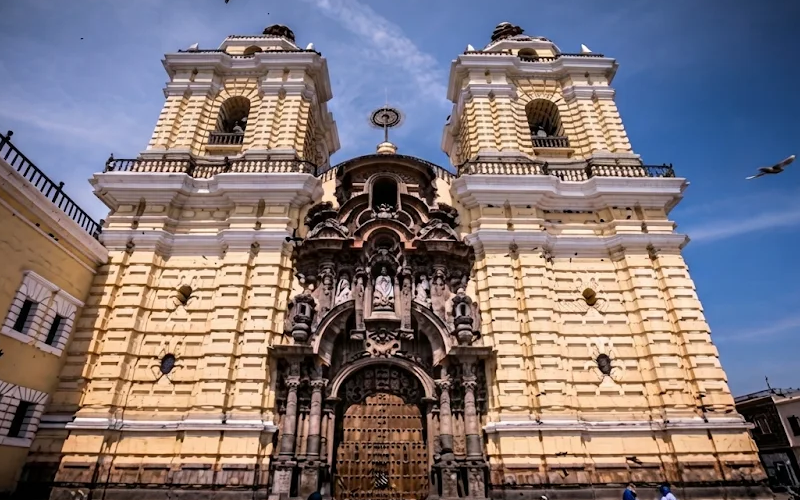
A few steps from Lima’s Plaza Mayor, under one of the most beautiful churches in South America, there is a second city made of brick vaults, narrow passages and thousands of human bones. The catacombs of Lima lie beneath the Basilica and Convent of San Francisco, and they are one of the most surprising visits in the historic center: part cemetery, part engineering marvel, part history lesson about how colonial Lima lived and died.
This guide was put together by Cristian, a MINCETUR-licensed tour guide who has spent more than 10 years showing Lima’s historic center to international travelers. Below you will find ticket prices, opening hours, what you will actually see underground, the story of the Hollywood star buried here and practical tips to plan your visit.
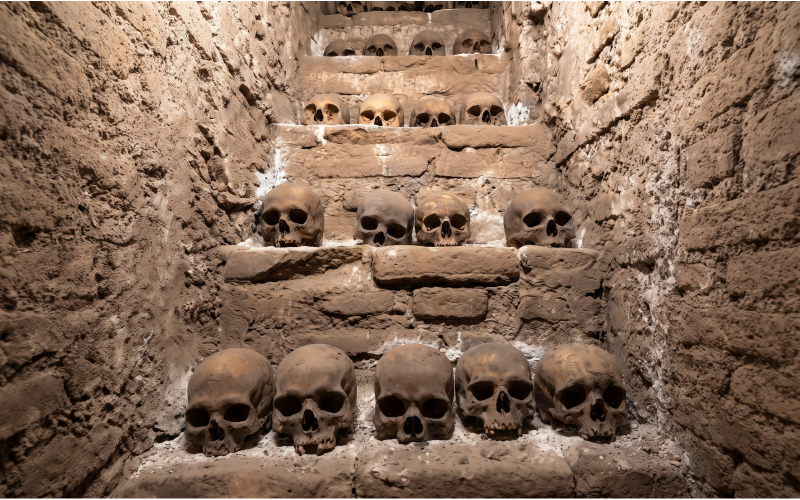
Quick answer: the catacombs of Lima are the underground crypts of the San Francisco convent, in the historic center (corner of Jirón Áncash and Jirón Lampa). They open every day from 9:00 a.m. to 6:00 p.m. Tickets cost S/ 20 for adults, S/ 10 for students and S/ 5 for children (roughly US$6, US$3 and US$1.50 as a reference), and include a guided tour of about 45 minutes in Spanish or English. Photos are not allowed inside.
Lima Catacombs Tickets, Hours and Visitor Information
The catacombs are visited as part of the Museo Convento San Francisco y Catacumbas. You cannot go down on your own: every visit is led by one of the museum’s guides, and one ticket covers both the convent and the crypts.
| Detail | What to expect |
|---|---|
| Opening hours | Monday to Sunday, 9:00 a.m. to 6:00 p.m., holidays included |
| Adult ticket | S/ 20 (about US$6) |
| Student ticket | S/ 10 (about US$3), bring your student ID |
| Child ticket | S/ 5 (about US$1.50) |
| Where to buy | At the museum entrance on the day; entry is first come, first served |
| Guided tour | Included and mandatory, in Spanish or English |
| Duration | About 45 minutes |
| Photos and video | Not allowed inside the museum or the catacombs |
| Address | Plazuela San Francisco, corner of Jirón Áncash and Jirón Lampa, Lima historic center |
What Are the Catacombs of Lima?
Strictly speaking they are crypts, not catacombs: the name stuck because they reminded visitors of the ones in Rome. The Franciscans arrived in Lima soon after the city was founded and began building their convent in 1546. The church you see today was completed in the 1670s, and the brick galleries underneath worked as the city’s main burial ground for generations.
Why bury people under a church? In colonial Lima, a baptized Christian wanted to rest inside the temple or as close to it as possible, because that was believed to keep the soul safer. The idea was so strong that the cemetery spread beyond the church itself, under the atrium and part of the small square in front.
Burials stopped in the early 19th century, when Lima opened its first general cemetery outside the city walls. The crypts were sealed and largely forgotten until they were rediscovered in the 1940s, and they opened to visitors in 1950. Researchers estimate that around 25,000 people were buried here, and some put the figure much higher. In 1968 the convent became a museum of religious art, and today the whole complex is part of Lima’s UNESCO World Heritage historic center.
What You Will See Underground
A short staircase takes you from the cloister down into the galleries, directly under the church floor. While you walk between the bones, people may be listening to mass a few meters above your head.
- The galleries and bone pits: long brick corridors lined with pits where femurs, tibias and skulls were sorted by type when the crypts were studied.
- The great ossuary well: a circular pit about 10 meters deep where skulls and long bones are arranged in rings. It is the image most people remember.
- Earthquake-proof engineering: the crypts have up to three levels, with brick pillars about 1.3 meters wide and vaults that work as columns. The convent’s guides say the mortar was mixed with seabird eggs. Whatever the recipe, the structure has survived centuries of Lima earthquakes.
- The view into the church: at one point a grille lets you look up into the nave, a reminder of how close the living and the dead were in colonial Lima.
- Coins in the pit: many European visitors toss a coin over their shoulder and make a wish, as they would at the Trevi Fountain in Rome.
Before You Go Down: Art and Devotion in the Convent
The tour does not start underground. On the way to the crypts you walk through a convent that would be worth the ticket by itself, with cloisters covered in Sevillian tiles, carved wooden ceilings and a library of about 25,000 old volumes that looks like a film set.
- The Passion triptych: near the entrance, three paintings by the Roman artist Angelino Medoro show the last moments of the life of Christ.
- El Niño Doctorcito: a small figure of the child Jesus dressed as a doctor, surrounded by letters and photos. Pregnant women and parents of sick children come to ask for a favor or to give thanks for one.
- Saint Francis and “Sister Death”: a sculpture of the saint holding a skull, which is how he referred to death. Look at his left hand to see the wound of the stigmata.
The Hollywood Star Buried in the Lima Catacombs
The most unexpected resident of San Francisco is not a viceroy or a saint. In the Crypt of the Venerables, a section that is normally closed to the public, rests José Mojica, a Mexican opera tenor and leading man who made films in Mexico, Argentina and Hollywood in the 1930s.
At the height of his fame he gave away his fortune and decided to become a Franciscan friar somewhere nobody would recognize him. According to the story told at the convent, he was thinking of India until a friend proposed a bet: close your eyes, point at a world map, and go wherever your finger lands. It landed on Cusco. Mojica entered the Franciscan order in Peru in 1942, was ordained in Lima in 1947 as Fray José Francisco de Guadalupe, and lived here until his death in 1974.
Tips for Visiting the Catacombs of Lima
- Go early or late: mid-morning is the busiest time, when large tour groups arrive. Arrive at opening or after 3:00 p.m. for shorter waits.
- Bring soles in cash: tickets are bought at the door, and small change makes it faster.
- Mind your head: the passages are narrow with low ceilings in places. If you are claustrophobic, tell the guide; the underground section is short.
- Put the camera away: no photos or video inside. You can take all the pictures you want of the facade and the square, which is full of pigeons and great for portraits.
- Combine it with the Plaza Mayor: the convent is about a five-minute walk from the Cathedral and the Government Palace, so it fits easily into a morning in the historic center.
On Your Own or With a Private Guide?
The museum’s own guide takes you through the convent and the crypts either way. The difference is everything around those 45 minutes: getting there, the wait, and understanding how San Francisco fits into the rest of colonial Lima.
| Visiting on your own | As part of a private tour | |
|---|---|---|
| Pace | You follow the museum group | The rest of the day moves at your pace, with no rush |
| Context | The convent and crypts only | The story continues at the Plaza Mayor, the Cathedral and the streets in between |
| Timing | You guess the best hour | Your guide picks the quietest moment to go in |
| Group | Shared with other visitors | Only your group for the walk around the center |
| Photos | Whatever you manage yourself | As many as you want outside, with someone to take them |
| Questions | Limited to the tour | Ask anything about Lima, before and after |
See the Historic Center With a Local
San Francisco is one piece of a much bigger story. On a private Lima City Tour, Cristian walks you through the Plaza Mayor, the Government Palace, the Cathedral and the colonial streets of the center, and if you want to include the catacombs he will plan the route and the timing around them. For more ideas, read our guide to the 15 best things to do in Lima or meet your guide.
Want to Visit the Catacombs With a Local Guide?
Tell Cristian your dates and he will plan a private walk through Lima’s historic center that includes San Francisco.
Plan My Visit on WhatsAppFrequently Asked Questions About the Catacombs of Lima
What are the catacombs of Lima?
The catacombs of Lima are the underground crypts of the Basilica and Convent of San Francisco, in the historic center of Lima, Peru. They were the city’s main burial ground during the colonial period, hold the remains of an estimated 25,000 people and are visited today as part of the Museo Convento San Francisco y Catacumbas.
How much are tickets for the Lima catacombs?
Tickets for the Lima catacombs cost S/ 20 for adults, S/ 10 for students and S/ 5 for children (roughly US$6, US$3 and US$1.50 as a reference). The ticket is bought at the museum entrance and includes the guided tour of both the San Francisco convent and the catacombs.
What are the opening hours of the catacombs of Lima?
The Museo Convento San Francisco y Catacumbas opens Monday to Sunday from 9:00 a.m. to 6:00 p.m., including holidays. Entry is first come, first served, so arrive at least 45 minutes before closing to join the last guided tours.
Can you visit the Lima catacombs without a guide?
No. Every visit to the convent and catacombs of San Francisco is led by one of the museum’s guides, and the tour is included in the ticket. Tours are offered in Spanish and English.
How long does the visit to the catacombs take?
The guided tour of the San Francisco convent and catacombs takes about 45 minutes. Allow around an hour and a half in total to buy tickets, wait for your group and see the church and the square outside.
Can you take photos inside the catacombs of Lima?
No. Photos and video are not allowed inside the San Francisco museum or the catacombs. You can photograph the facade of the church and the square in front of it.
How many people are buried in the catacombs of Lima?
Around 25,000 people are estimated to be buried in the catacombs of San Francisco in Lima, although some researchers believe the number could be much higher. Burials took place during the colonial period and stopped in the early 19th century, when the city opened its first general cemetery.
Are the Lima catacombs scary or suitable for children?
The Lima catacombs display real human bones in narrow, dimly lit passages, so some visitors find them unsettling, but the tone of the tour is historical rather than frightening. Children can visit and pay a reduced ticket; parents should decide based on the child. People with claustrophobia should know the ceilings are low in places, although the underground section is short.
Where are the catacombs of Lima and how do you get there?
The catacombs of Lima are under the San Francisco church, at the corner of Jirón Áncash and Jirón Lampa in the historic center, about a five-minute walk from the Plaza Mayor. From Miraflores, a taxi or ride-hailing app takes roughly 30 to 45 minutes depending on traffic.
Who is the Hollywood actor buried in the Lima catacombs?
José Mojica, a Mexican opera tenor and film actor who worked in Mexico, Argentina and Hollywood, is buried in the Crypt of the Venerables at San Francisco in Lima. He left his career to become a Franciscan friar in Peru in 1942, took the name Fray José Francisco de Guadalupe and died in Lima in 1974.
Ready to Explore Colonial Lima?
Discover the historic center with a MINCETUR-licensed local guide: your group, your pace, your itinerary.
Message Cristian on WhatsApp